
Frequently Asked Questions
Find answers to common questions about concrete cutting, core drilling, pricing, safety, and permits in Massachusetts.
General
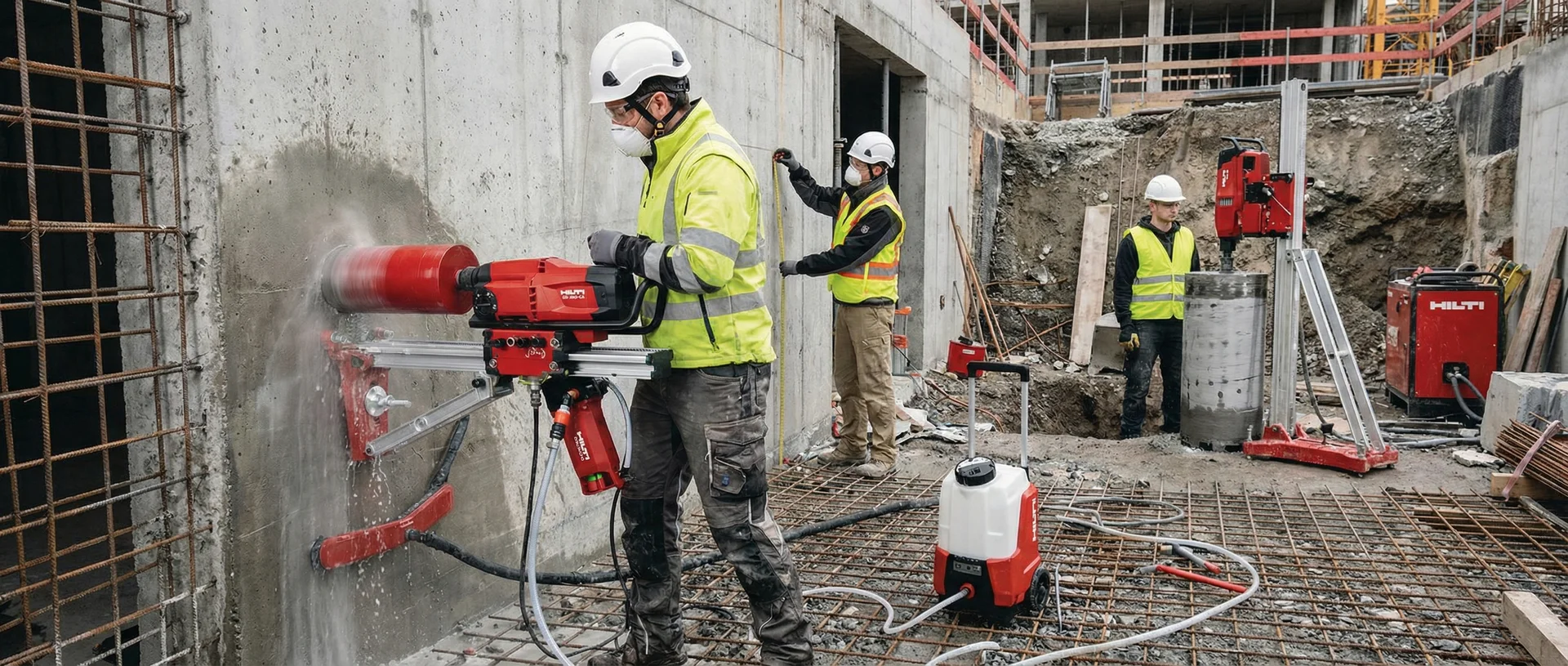
Concrete cutting is the process of sawing, drilling, or removing concrete using diamond-tipped blades and bits. It is needed whenever you have to create openings, penetrations, or modifications in existing concrete structures. Common applications include cutting trenches in basement floors for plumbing, drilling holes through foundation walls for HVAC or electrical lines, cutting egress window and door openings, and removing damaged sections of driveways or sidewalks. Professional concrete cutting produces clean, precise results without damaging the surrounding concrete.
Concrete cutting uses diamond blades and core bits to make precise, controlled cuts in concrete, preserving the surrounding material in perfect condition. Concrete demolition, by contrast, uses jackhammers, hydraulic breakers, or other impact methods to break concrete apart, which is faster for full removal but cannot produce clean edges or precise openings. When you need a clean opening, penetration, or modification in concrete that will remain in place, concrete cutting is the appropriate method. When the concrete is being entirely removed and precision does not matter, demolition may be more efficient.
REDCORE provides a full range of concrete cutting and core drilling services, including flat sawing (slab sawing) for cutting horizontal surfaces like floors and driveways, wall sawing for creating openings in vertical concrete walls, core drilling for creating precise round holes of any diameter through concrete floors and walls, hand sawing for smaller cuts and access-limited areas, and controlled demolition for concrete removal. We also offer emergency same-day concrete cutting services. We handle residential, commercial, and industrial projects throughout Western and Central Massachusetts.
Yes. Our diamond blades and core bits are designed to cut through reinforced concrete, including rebar, wire mesh, and other embedded steel. Cutting through reinforcement takes more time and causes more blade wear than cutting unreinforced concrete, which may affect pricing, but it does not prevent us from completing the cut. If you know your concrete is reinforced, please mention it when requesting a quote so we can provide accurate pricing and schedule adequate time for the job.
REDCORE Concrete Cutting & Core Drilling serves all of Western and Central Massachusetts, covering 5 counties and over 50 cities and towns. Our primary service area includes Hampden County (Springfield, Chicopee, Holyoke, Westfield, West Springfield, Agawam), Hampshire County (Northampton, Amherst, Easthampton, South Hadley), Franklin County (Greenfield, Turners Falls, Orange), Berkshire County (Pittsfield, North Adams, Great Barrington), and Worcester County (Worcester, Shrewsbury, Leominster, Fitchburg). We are based in Springfield, MA and offer same-day emergency service throughout our coverage area. Contact us for availability at your location.
Pricing
Core drilling costs depend primarily on the hole diameter, the thickness of the concrete, and whether the concrete is reinforced. As a general guide, small holes (1 to 3 inches) range from $75 to $150 per hole, medium holes (4 to 6 inches) range from $125 to $250 per hole, and large holes (7 to 12 inches) range from $200 to $400 per hole. Volume discounts are available when multiple holes are needed on the same visit. We provide free estimates for all projects, so contact us with your specific requirements for an accurate quote.
Yes, like most concrete cutting companies, REDCORE has a minimum job charge that typically ranges from $250 to $500 depending on the type of service. This minimum covers mobilization costs including travel time, equipment transport, setup, and breakdown. For very small jobs such as a single core drill hole, the minimum charge may exceed the per-hole rate. Combining multiple small tasks into a single visit is a cost-effective way to maximize value and often brings the effective per-item cost well below what separate visits would cost.
The concrete cutting portion of an egress window installation typically costs between $800 and $2,000 in the Springfield, MA area. The primary cost factors are the wall thickness (8-inch walls cost less than 12-inch walls), whether the wall is poured concrete or concrete block, the size of the opening, and whether the concrete is reinforced. Keep in mind that this covers only the concrete cutting; the total egress window project, including excavation, the window well, the window unit, waterproofing, and interior finishing, typically ranges from $3,000 to $8,000 total.
Yes, REDCORE provides free, no-obligation estimates for all concrete cutting and core drilling projects. For straightforward jobs like standard core drilling or simple flat sawing, we can often provide an accurate estimate over the phone based on the information you provide. For more complex projects, such as egress window cutouts or large structural openings, we may recommend an on-site visit to assess the concrete conditions, access, and any special requirements before providing a final quote.
Yes, REDCORE offers competitive trade pricing for plumbers, HVAC contractors, electricians, and general contractors who use our services regularly. We also offer volume pricing when multiple cuts or holes are needed on the same project. Establishing a trade account is simple and provides benefits including priority scheduling and consistent preferred rates. Contact us to discuss trade account options and learn how a regular working relationship can benefit your business.
Process
Job duration varies significantly depending on the type and scope of work. A single core drill hole through a standard basement wall typically takes 15 to 30 minutes of actual drilling time plus setup. Multiple core drill holes on the same job might take 2 to 4 hours total. An egress window opening typically takes 3 to 5 hours. Flat sawing a trench in a basement floor takes 1 to 3 hours depending on length and depth. We will provide a time estimate when you schedule your job so you can plan your day and coordinate with other trades.
Clear the work area of all items, furniture, and stored belongings for at least 6 to 8 feet around the cutting location. Protect finished surfaces near the work area with plastic sheeting or drop cloths. Ensure an electrical outlet (20-amp, 110V) is available within 100 feet of the work area, and a garden hose connection is accessible for water supply. Move vehicles away from exterior work areas, and keep children and pets away from the work zone. We provide specific preparation instructions tailored to your project when you schedule your appointment.
Professional wet concrete cutting produces very little airborne dust because water is applied to the blade during cutting, capturing dust particles before they become airborne. However, the water does mix with concrete particles to form a slurry that must be managed. For interior work, we contain and clean up slurry as part of our standard service. Some residual moisture and fine dust may remain after the job, but the difference between professional wet cutting and dry methods is dramatic. Our goal is always to leave your property clean.
Yes, a large portion of our work is performed indoors, including basement floor cutting, foundation wall drilling, and interior slab modifications. Indoor concrete cutting requires careful water management and dust control, both of which are standard parts of our process. We use wet cutting to suppress dust and contain slurry to protect finished surfaces. For occupied buildings, we take additional precautions to minimize disruption, including protecting flooring along our access path and isolating the work area from living spaces when possible.
For core drilling, the removed material is a solid cylindrical plug (the 'core') that we remove and can either leave on site or dispose of for you. For flat sawing trenches, the slab sections between the cuts are typically broken out and removed by the general contractor or plumber. For wall sawing openings like egress windows and doorways, the cut-out section can be very heavy, often several hundred pounds, and we handle its safe removal from the wall. Discuss debris removal and disposal with us when scheduling so we can include it in your quote if needed.
Safety
When performed by qualified professionals using proper equipment and methods, concrete cutting is safe for building occupants. The primary concern is silica dust, which is effectively controlled through wet cutting methods that prevent dust from becoming airborne. We recommend that occupants stay out of the immediate work area during cutting operations, and we isolate the work zone from living spaces when possible. After the job is complete, we clean up the work area to remove any residual dust or slurry. Keeping children and pets away from the work area during active cutting is important.
Professional concrete cutting does not damage surrounding concrete. Unlike jackhammering or impact methods, diamond blade cutting produces no shock waves or vibrations that could crack adjacent areas. However, creating large openings in foundation walls or structural slabs does change the load path of the structure, which is why structural engineering review is important for significant modifications. When an opening requires a header or lintel, it should be designed by a licensed engineer and installed before or immediately after the concrete is removed. Small penetrations like core drill holes for pipes and conduit have no meaningful structural impact.
Concrete cutting generates significant noise, typically in the range of 90 to 110 decibels, comparable to a gas-powered leaf blower or a loud lawnmower. Our operators wear hearing protection at all times during cutting. If you plan to be in or near the work area, we recommend wearing earplugs or ear muffs. The noise is typically intermittent rather than continuous, with pauses between cuts. For residential projects, we are mindful of local noise ordinances and schedule work during permitted hours. Informing your neighbors about the expected noise is a courteous step we recommend.
Yes, REDCORE Concrete Cutting & Core Drilling carries comprehensive insurance coverage including general liability insurance and workers' compensation insurance. We are happy to provide certificates of insurance upon request, which is a common requirement for commercial projects and for general contractors who need proof of subcontractor coverage. We strongly recommend that homeowners and contractors verify insurance coverage for any concrete cutting company they hire, as working with an uninsured contractor exposes you to significant financial liability in the event of an accident or property damage.
Stay out of the immediate work area during active cutting. Keep children, pets, and other household members away from the work zone. Wear hearing protection if you need to be nearby. Close doors and windows between the work area and living spaces to minimize dust and noise migration. Do not walk through wet slurry with bare feet, as it is highly alkaline and can irritate skin. After the work is complete, wet-mop the area rather than sweeping to avoid re-suspending any settled dust. Cover any open holes or openings to prevent tripping or falls until they are permanently closed or finished.
Permits & Regulations
It depends on the nature of the work. Structural modifications such as egress window openings, door openings in foundation walls, and floor openings for stairways require a building permit in all Massachusetts municipalities. Minor penetrations for plumbing pipes, electrical conduit, dryer vents, and similar utility connections generally do not require a separate building permit for the cutting itself, though the plumbing or electrical work that follows may have its own permit requirements. When in doubt, contact your local building department before scheduling the work. They can tell you exactly what permits are needed for your specific project.
REDCORE does not typically pull building permits on behalf of clients, as the permit is generally the responsibility of the property owner or the general contractor managing the project. However, we are happy to advise you on whether your project is likely to require a permit based on our experience with local building departments throughout Western Massachusetts. We can also provide documentation of our work, including dimensions and methods, that may be requested by building inspectors during the inspection process.
The Massachusetts building code requires that every sleeping room in a basement have at least one emergency escape and rescue opening. The minimum net clear opening area must be 5.7 square feet, with a minimum height of 24 inches and minimum width of 20 inches. The window sill cannot be more than 44 inches above the finished floor. If the window is below grade, a window well must be installed with a minimum horizontal area of 9 square feet and a minimum dimension of 36 inches. Window wells deeper than 44 inches require a permanently attached ladder or steps. These requirements are critical to understand before ordering concrete cutting for an egress window opening.
If your project involves any excavation or cutting into the ground near where utilities may be buried, Massachusetts law requires you to call 811 (Dig Safe) at least 72 hours before digging. This is a free service that sends utility companies to mark the approximate location of their underground lines. For interior concrete cutting, such as cutting a basement floor, Dig Safe may not cover interior utilities, so it is important to independently verify the location of any plumbing, electrical, or gas lines that may run beneath or through the concrete being cut. Your contractor, plumber, or electrician can help identify these locations.
Yes, most Massachusetts municipalities have noise ordinances that restrict the hours during which construction work, including concrete cutting, can be performed, especially in residential areas. In Springfield and most surrounding communities, construction noise is typically permitted between 7:00 AM and 6:00 PM on weekdays and 8:00 AM to 5:00 PM on Saturdays, with no construction noise permitted on Sundays and holidays. Specific hours vary by municipality, so check your local ordinances. REDCORE schedules all work within permitted hours and can advise on local regulations when you book your appointment.
Still Have Questions?
Contact us directly. We are happy to answer any questions about your concrete cutting project.