
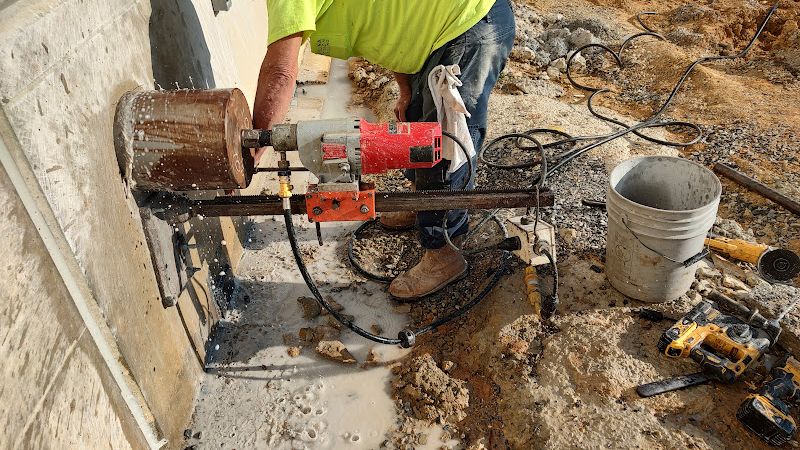
Diamond Core Drilling Defined
Diamond core drilling is a concrete cutting technique that uses a hollow, cylindrical drill bit with diamond-impregnated segments to grind a circular hole through concrete, masonry, brick, stone, or asphalt. Unlike percussion drilling, which hammers through the material, core drilling uses rotational grinding to create a smooth, precisely sized opening. The process leaves behind a solid cylindrical piece of the material, called the core, which is removed after the hole is complete.
The technique is used throughout the construction industry for creating holes for plumbing pipes, HVAC ductwork, electrical conduit, structural anchors, and dozens of other applications. If you own a home or commercial property in Massachusetts, there is a good chance that diamond core drilling was used at some point during its construction or renovation.
How Diamond Core Drilling Works
The core drilling process involves several components working together:
The Core Bit
The core bit is a steel tube with diamond-embedded segments brazed or laser-welded to the cutting end. Synthetic industrial diamonds, which are among the hardest materials known, are suspended in a metal bond matrix. As the bit rotates against the concrete, these diamond crystals abrade the material at the cutting face. The diamonds gradually wear and fracture during use, continually exposing fresh, sharp cutting surfaces. This self-sharpening property is what makes diamond tooling so effective and long-lasting.
Core bits are manufactured in standard diameters from 1 inch to over 60 inches. The most common sizes for residential and light commercial work range from 2 inches to 12 inches. The bit length determines the maximum drilling depth in a single pass, typically 12 to 18 inches for standard bits, with extension rods available for deeper holes.
The Drill Rig
Professional core drilling uses a rig, also called a drill stand or drill motor assembly, that secures the drill motor and core bit in a fixed position. The rig consists of a column mounted to a base plate, with the drill motor traveling up and down the column on a carriage. The operator advances the bit into the concrete by turning a hand wheel or engaging a hydraulic feed.
The rig is anchored to the concrete surface using expansion anchors or a vacuum pad. This anchoring is critical: it prevents the rig from spinning or walking when the bit engages the concrete, ensuring the hole is drilled in the exact location and at the exact angle specified. Drill motor power typically ranges from 15 to 40 amps for electric rigs, with hydraulic rigs available for larger diameters and higher-torque applications.
Water Supply
Nearly all professional core drilling is performed wet, with water flowing through the center of the core bit to the cutting face. The water serves three purposes: it cools the diamond segments to prevent thermal damage, it lubricates the cutting interface for smoother operation and faster penetration, and it captures the concrete dust produced during drilling, converting it to a manageable slurry rather than hazardous airborne particles. Water is typically supplied from a standard garden hose at low pressure.
What Materials Can Be Core Drilled?
Diamond core drilling cuts through virtually any cementitious, masite, or stone material:
- Poured concrete: The most common material drilled, including residential foundations, basement floors, commercial slabs, and structural walls. Massachusetts homes built after the 1950s typically have poured concrete foundations 8 to 10 inches thick.
- Concrete block (CMU): Older Massachusetts homes, particularly in Springfield, Holyoke, and Chicopee, often have concrete block foundations. Core drilling handles both the block and any grout-filled cells.
- Brick: Core drilling through brick walls produces clean holes without the cracking and spalling that percussion methods cause in brick.
- Natural stone: Granite, limestone, marble, and fieldstone are all drillable with appropriate diamond tooling. Historic buildings in Worcester and Pittsfield sometimes require core drilling through stone foundations.
- Reinforced concrete: Diamond core bits cut through embedded rebar, wire mesh, and fiber reinforcement. The bit cuts the steel and concrete simultaneously without deflection or stalling.
- Asphalt: Core samples for pavement testing and utility access through asphalt surfaces are common core drilling applications.
Need this done professionally?
REDCORE provides free, no-obligation estimates. Same-day service available.
Get Free Estimate →Or call: +1 (413) 666-2026Common Applications in Massachusetts Construction
Residential Applications
- Plumbing penetrations: Holes through basement floors and foundation walls for drain pipes, water supply lines, and sewer connections. Typical sizes: 2-inch to 6-inch diameter.
- Mini-split HVAC installations: A 3-inch to 4-inch hole through an exterior wall for the refrigerant line set, wiring, and condensate drain. This is currently the single most common residential core drilling request in Massachusetts.
- Dryer vent installation: A 4-inch hole through the foundation or exterior wall for the dryer exhaust duct.
- Radon mitigation: A 4-inch to 5-inch hole through the basement slab for the radon extraction pipe. The EPA recommends radon testing and mitigation for Massachusetts homes, as many areas have elevated radon levels.
- Electrical and data: Holes from 1 inch to 3 inches for electrical conduit, data cables, and communication wiring.
Commercial Applications
- Ductwork penetrations: Larger-diameter holes (6 to 18 inches) through concrete floors and walls for HVAC duct routing in office buildings, hospitals, and schools.
- Fire sprinkler risers: Precise holes through concrete floors for fire sprinkler system piping.
- Structural anchoring: Holes for post-installed anchors, dowels, and rebar connections in concrete repair and retrofit projects.
- Material testing: Core samples extracted from existing concrete for compressive strength testing by engineering firms.
Core Drilling vs. Other Drilling Methods
Core drilling is often compared to two alternative methods:
- Rotary hammer drilling: Uses a carbide-tipped bit with percussive impact. Effective for small holes (under 1-1/2 inches) but produces rough, imprecise results in larger diameters. Cannot cut through rebar. Suitable for anchor holes and small conduit, not for pipe penetrations.
- Hole saws: Carbide or diamond-grit hole saws used with standard drills. Limited to thin materials (under 4 inches) and small diameters (under 6 inches). Produces lower-quality holes than a professional core drill rig. Suitable for thin masonry veneer but not for structural concrete.
For any hole larger than 1-1/2 inches through structural concrete, professional diamond core drilling is the clear choice.
What Core Drilling Costs in Massachusetts
Core drilling pricing depends primarily on hole diameter, concrete thickness, and the number of holes:
- Small holes (1 to 3 inches): $75 to $150 per hole
- Medium holes (4 to 6 inches): $125 to $250 per hole
- Large holes (7 to 12 inches): $200 to $400 per hole
- Extra-large holes (12+ inches): $350 to $700 or more per hole
Most contractors have a minimum job charge of $250 to $500, which covers mobilization and setup. Volume discounts are standard when multiple holes are drilled in a single visit, so batching your core drilling needs saves significant money.
Choosing a Core Drilling Professional
For Massachusetts projects, look for a core drilling contractor who carries full general liability and workers' compensation insurance, uses professional-grade rig-mounted equipment rather than handheld drills, employs wet cutting as standard practice for dust control, and has experience with your specific type of project and building material. REDCORE Concrete Cutting & Core Drilling provides professional diamond core drilling services throughout Springfield, Worcester, Pittsfield, and all of Western Massachusetts. Contact us for a free estimate on your next project.