
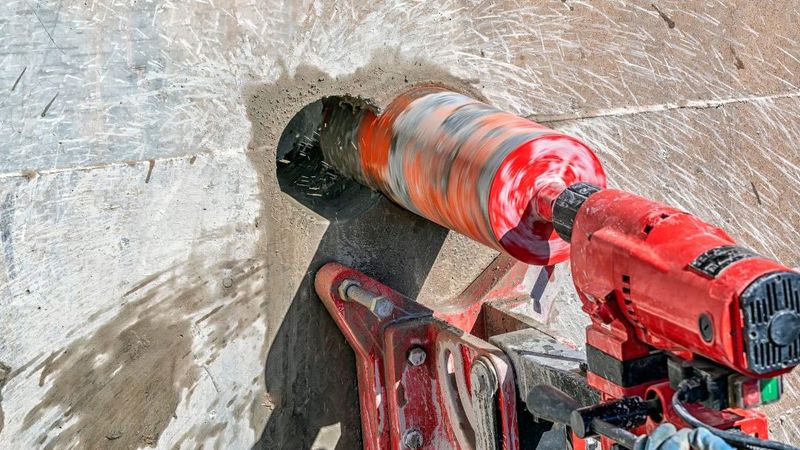
Why Mini-Splits Need Core Drilling
Ductless mini-split heat pumps have become one of the most popular heating and cooling solutions for Massachusetts homes, especially for additions, finished basements, and older homes without existing ductwork. Every mini-split installation requires at least one penetration through an exterior wall to connect the indoor unit to the outdoor condenser. This penetration must accommodate the refrigerant line set, the electrical wiring, and the condensate drain line.
While some installers use a hole saw or even a hammer drill to create this penetration, professional core drilling produces a far superior result. A core-drilled hole is perfectly round, smooth-walled, and precisely sized, which means better sealing, cleaner installation, and reduced risk of water infiltration.
Standard Hole Sizes for Mini-Split Installations
The required hole size depends on the mini-split system being installed:
- Single-zone systems (9,000-18,000 BTU): A 3-inch diameter hole is standard and accommodates the line set, wiring, and condensate drain for most single-zone units.
- Larger single-zone systems (24,000-36,000 BTU): Some larger units require 3.5-inch or 4-inch holes due to larger refrigerant lines.
- Multi-zone branch lines: Each indoor unit in a multi-zone system needs its own penetration, typically 3 inches in diameter.
- Trunk lines for multi-zone systems: The main line set from the outdoor unit may require a 4-inch or larger hole if multiple branch lines are routed together.
Always verify the manufacturer's installation manual for the specific system being installed. Different manufacturers and models have different line set sizes and clearance requirements.
Hole Placement Considerations
Proper hole placement is critical for both performance and aesthetics:
- Height: The hole should be positioned directly behind the indoor unit's connection area, typically near the bottom-right or bottom-left side of the unit depending on the manufacturer. The hole should slope slightly downward toward the exterior to ensure condensate drainage.
- Interior clearance: Ensure there is adequate clearance inside the wall cavity. Check for studs, wiring, plumbing, and insulation before drilling.
- Exterior clearance: The hole exit point on the exterior must have adequate clearance for the line set to run down to the outdoor unit. Avoid locations where the line set cover would interfere with windows, doors, or other features.
- Structural members: Never drill through a structural header, beam, or post. The hole should pass through the wall between studs in wood-frame construction, or through the appropriate location in masonry or concrete walls.
Core Drilling Through Different Wall Types
Wood Frame with Siding
This is the simplest scenario. A standard core drill or hole saw can penetrate the sheathing, insulation, and siding. The main concern is locating studs and any wiring within the wall cavity. A stud finder and wire detector should be used before drilling.
Poured Concrete or Block Foundation Walls
For basement mini-split installations, the line set often needs to pass through a concrete foundation wall. This is where professional core drilling truly shines. A diamond core drill creates a clean, precise hole through 8 to 12 inches of concrete, including any rebar encountered. Hammer drilling or hole saws cannot produce the same quality result in concrete.
Brick or Stone Veneer
Homes with brick veneer require drilling through the brick layer, an air gap, and the structural wall behind it. Core drilling handles the brick cleanly without the cracking and spalling that can occur with other methods.
Need this done professionally?
REDCORE provides free, no-obligation estimates. Same-day service available.
Get Free Estimate →Or call: +1 (413) 666-2026The Downward Slope Is Critical
One of the most important details of a mini-split wall penetration is the slope. The hole must angle slightly downward from interior to exterior, typically at a 3 to 5 degree slope. This ensures that any condensate that enters the line set hole drains to the outside rather than running down the interior wall.
A professional core drilling operator will set the drill rig at the correct angle to achieve this slope. If the hole is level or slopes inward, water can accumulate inside the wall cavity, leading to mold growth, rot, and interior water damage.
Sealing and Finishing
After the core hole is drilled and the line set is installed, proper sealing is essential:
- A wall sleeve or grommet should be installed in the hole
- The gap between the line set and the sleeve should be sealed with putty or foam designed for HVAC applications
- The exterior should be sealed with weatherproof caulk
- A line set cover should be installed on the exterior for both aesthetics and protection
Coordination Between HVAC Contractor and Core Driller
The most efficient approach is for the HVAC contractor to mark the exact hole location and size before the core drilling appointment. The core driller can then complete the penetration, and the HVAC installer can return to run the line set and complete the installation. Some HVAC contractors prefer to be on site during the drilling to verify the location before the drill starts.
REDCORE's Mini-Split Core Drilling Service
REDCORE Concrete Cutting & Core Drilling provides fast, precise core drilling for mini-split installations throughout Springfield, MA and Western Massachusetts. We work regularly with HVAC contractors and understand the specific requirements for line set penetrations. Contact us to schedule your next mini-split core drilling job.