
Concrete Cutting Is Central to Basement Renovations
If you are finishing your basement in Massachusetts, whether in Springfield, Worcester, Pittsfield, or anywhere in between, concrete cutting is not a side task. It is one of the first and most important phases of the project. Your basement is surrounded by concrete: the floor slab, the foundation walls, and often concrete block partition walls. Every new plumbing drain, every window opening, every HVAC connection, and every waterproofing improvement requires cutting through that concrete before the work behind it can proceed.
Understanding the full scope of concrete cutting before you break ground helps you build an accurate budget, schedule trades efficiently, and avoid costly surprises midway through the renovation. This guide walks you through every common concrete cutting element in a basement renovation project.
Egress Windows: The Code Requirement
If your basement renovation includes a bedroom, a home office used for sleeping, or any habitable space that the Massachusetts building code classifies as a sleeping room, you are required to have an emergency egress window. The Massachusetts State Building Code, based on the International Residential Code with state amendments, mandates specific minimums:
- Minimum net clear opening area: 5.7 square feet
- Minimum net clear opening height: 24 inches
- Minimum net clear opening width: 20 inches
- Maximum sill height from finished floor: 44 inches
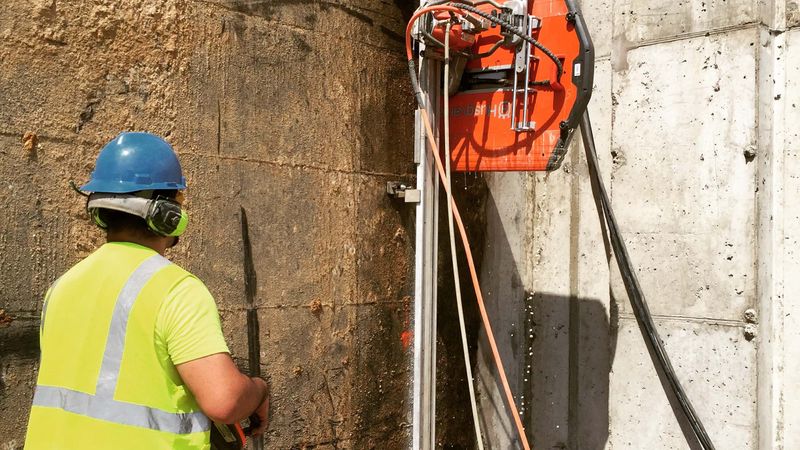
Creating this opening requires wall sawing through your poured concrete or block foundation wall. The rough opening will be several inches larger than the window dimensions on all sides to accommodate the frame, header, and finishing materials. A typical egress window cutout in an 8-inch to 10-inch poured concrete wall takes 1 to 3 hours of wall sawing time and costs $800 to $2,000 for the cutting alone.
Before cutting, the exterior must be excavated to the full depth of the opening, and if specified by a structural engineer, temporary shoring must be installed inside. After cutting, a steel or concrete lintel is installed above the opening to transfer the load around it.
Bathroom Plumbing: Trench Cuts and Core Holes
Adding a bathroom to your basement is one of the most common renovation goals, and it requires the most extensive concrete cutting. A full basement bathroom typically needs:
Flat Saw Trench Cuts
- Toilet drain trench: A trench approximately 12 to 18 inches wide running from the toilet location to the main sewer line connection. For a toilet, the plumber needs a 3-inch or 4-inch drain line beneath the slab.
- Shower or tub drain trench: A trench from the shower base or tub drain to the main drain line. Shower drains are typically 2-inch lines.
- Sink drain trench: If the sink drain cannot gravity-feed above the slab, a trench cut provides access for below-slab drainage. Sink drains are typically 1-1/2-inch or 2-inch lines.
- Total trench cutting: A typical basement bathroom requires 15 to 40 linear feet of trench cutting, depending on the bathroom layout and distance to the main sewer connection. At $6 to $12 per linear foot, budget $100 to $500 for the trench cutting portion.
Core Drilling
- Sewer line exit: If the main sewer exits through the foundation wall, a 4-inch to 6-inch core hole may be needed for the new connection.
- Vent stack penetration: The plumbing vent may need to pass through the slab or wall, requiring a 2-inch to 4-inch core hole.
- Water supply penetrations: Hot and cold supply lines entering through the wall or floor require 1-inch to 2-inch core holes.
French Drain and Waterproofing Systems
Massachusetts basements are notorious for water issues. The region's heavy rainfall, snowmelt, and high water tables drive thousands of basement waterproofing projects every year. An interior French drain system requires flat sawing a perimeter trench around the inside edge of the basement floor, typically 10 to 14 inches from the foundation wall.
- Perimeter trench cutting: A full-perimeter French drain in a 1,000-square-foot basement requires approximately 125 to 140 linear feet of slab cutting. The cuts are typically 10 to 12 inches apart, forming a narrow trench that houses the drain tile pipe.
- Sump pit core: The sump pump pit is created by core drilling an 18-inch to 24-inch diameter hole through the slab, or by making a square cutout with a flat saw.
- Cost estimate: Flat sawing for a full-perimeter French drain system typically costs $800 to $2,000, depending on the basement footprint and slab conditions.
Need this done professionally?
REDCORE provides free, no-obligation estimates. Same-day service available.
Get Free Estimate →Or call: +1 (413) 666-2026HVAC Penetrations
Heating and cooling your new basement living space requires penetrations for ductwork, piping, or line sets:
- Mini-split line sets: A 3-inch to 4-inch core hole through the foundation wall or rim joist area for each ductless mini-split indoor unit. Mini-splits are the most popular heating and cooling solution for Massachusetts basement renovations because they require no existing ductwork.
- Duct extensions: If you are extending your existing forced-air system, duct penetrations through concrete walls or between floor levels may require 6-inch to 12-inch core holes.
- Exhaust vents: Bathroom exhaust fans require a 4-inch core hole through the foundation wall or rim joist for the duct termination.
- Dryer vent: If your renovation includes a laundry area, a 4-inch core hole for the dryer exhaust duct is needed.
Electrical and Data Penetrations
Electrical work for a finished basement may require core drilling for conduit runs through foundation walls, especially if the electrical panel is on the opposite side of the wall from the renovation space or if sub-panels are being installed. Typical penetrations are 1-inch to 2-inch diameter core holes. Data and communication wiring for home offices, media rooms, and networking equipment may also require small penetrations.
Sequencing the Work
The order in which concrete cutting happens relative to other trades is critical for an efficient renovation:
- Phase 1 - Exterior excavation (if needed for egress windows): Must be complete before wall sawing.
- Phase 2 - All concrete cutting: Schedule all flat sawing, wall sawing, and core drilling in a single mobilization. This is the most cost-effective approach and prevents scheduling conflicts between trades.
- Phase 3 - Plumbing rough-in: The plumber installs drain lines, supply lines, and vent piping in the open trenches and through the core-drilled holes.
- Phase 4 - Plumbing inspection: The municipal plumbing inspector reviews the rough-in before the trenches are closed.
- Phase 5 - Concrete patching: Trenches are backfilled and the slab is patched with new concrete.
- Phase 6 - Remaining trades: Framing, electrical, HVAC, insulation, drywall, and finish work proceed.
Delays in the concrete cutting phase cascade through every subsequent trade. If the flat saw crew cannot cut until next week, the plumber cannot rough in, the inspector cannot inspect, and the concrete cannot be patched, pushing the entire project back.
Total Concrete Cutting Budget for a Basement Renovation
Here is a realistic budget range for the concrete cutting scope of a typical Massachusetts basement renovation that includes a bedroom, a bathroom, and a living area:
- Egress window wall sawing: $800 to $2,000
- Bathroom trench cutting: $400 to $1,200
- Core drilling for plumbing (3-5 holes): $300 to $800
- Mini-split penetration: $150 to $300
- French drain perimeter cutting (if needed): $800 to $2,000
- Miscellaneous penetrations: $100 to $400
- Total estimate: $2,550 to $6,700
The wide range reflects variations in basement size, wall thickness, reinforcement, and the specific scope of the renovation. Getting a detailed estimate from your concrete cutting contractor early in the planning process helps you build a budget you can count on.
Start Planning Early
REDCORE Concrete Cutting & Core Drilling works with homeowners and general contractors throughout Springfield, Worcester, Pittsfield, and Western Massachusetts on basement renovation projects of every scale. We can assess your full concrete cutting scope during a free site visit and provide a comprehensive estimate that covers every cut, hole, and opening your renovation requires. Contact us early in your planning process to keep your project on schedule and on budget.